There is a straightforward way to go about planning an ethical Indigenous tourism trip: with curiosity, respect and the necessary permissions. Put your money where it will do some good by supporting Traditional Owners and local communities, select an operator run by Indigenous people and take time to understand the cultural mores of the region.
I am Rhys McDonald, a travel writer hailing from Wales who makes his home close to Hobart. Dealing in visitor information, regional travel and outdoor travel has shown me the makings of a sound itinerary. It is not the one with the greatest number of stops on paper but the kind that does not put Country to use as a prop for your holiday pictures and allows you to be flexible and to listen.
In Australia you can partake in Aboriginal cultural tourism in a city or the remotest parts of the country; there are homelands stays, art and wildlife tours, storytelling, visits to cultural centres, bush food and guided walks, including traditional knowledge experiences in the desert. The more ethical offerings will impart some cultural education and leave no doubt as to how a visitor should conduct himself.
What Makes Indigenous Tourism Ethical?
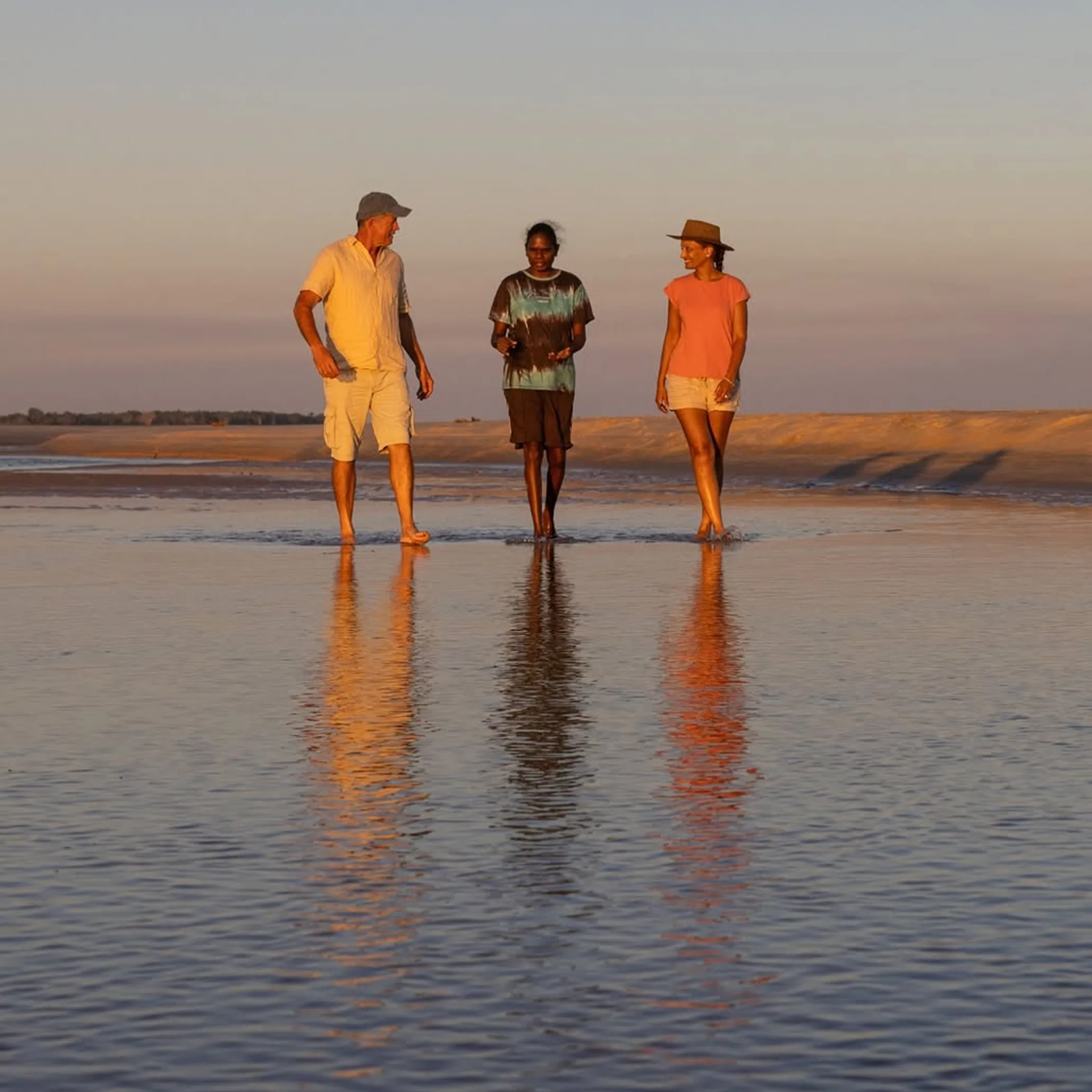
It is a matter of control. The experience ought to be in the hands of Indigenous people who can determine what is put on display and see a fair return for their trouble. Do not be swayed by a well put together website into thinking an operator has the best interests of Traditional Owners at heart.
You want to find a business that is owned, managed or put in place by Aboriginal or Torres Strait Islander people. A good operator will set out the cultural boundaries ahead of time, stick to authorised routes and not make light of sacred knowledge for the amusement of guests.
Read Beyond The Marketing
Make an effort to get the facts on community partnerships, cultural permissions and who the guides and owners are. An Indigenous-led operator will tell you whose Country you are treading on and the reason for any restrictions on activities or stories.
Be wary of “ancient secrets” proffered by a company that does not put a name to the community or Country in question. There is no call for mystery-box marketing when an authentic experience is built on consent, context and being paid fairly.
Then there are the tenets of responsible tourism in Australia: environmental care, keeping groups small, fair employment and setting the record straight with visitors. You will find that respecting the culture and the environment go hand in hand since Country is not something to be used up.
Indigenous-Led Operators
The booking decision of consequence is which operator to go with. With everything on offer in Indigenous tourism Australia from a walk in the city to several days in the desert, judge the calibre of the cultural leadership and not the stars.
Tourism Australia and the various state and regional bodies are of assistance in locating Aboriginal experiences. For the Kimberley, Pilbara and South West, Tourism Western Australia is a good resource; in the NT, start with Tourism and Events NT.
Ownership And Leadership
Find out before you book who is behind the business and if they have the right to be on Country. Any Aboriginal guide worth his salt will know the cultural protocols and will not be giving away stories to those who have no claim to them.
If the operator cannot tell you whose Country you are visiting, consider it a red flag and not just an oversight on the site. Ecotourism Australia accreditation is one way to measure up to standards but it should complement your own due diligence.
A Booking Checklist
- Verify that the operator is Indigenous-owned or has a transparent partnership with the community.
- Whose Country is it and is the guide authorised?
- See what the physical demands are and check the terms for cancellation, accessibility and the weather.
- Are there limitations on photography, recording or handling objects?
- Get confirmation on inclusions like accommodation, meals, permits and park fees.
Do not mistake limited departures for anything less than good service; the guide has family and other obligations on Country. One does not turn culture into a daily stage show.
On Cultural Protocols
These are not put in place to put travellers to inconvenience. They are a means of showing proper regard for the authority and the stories of a place. A little homework before you get there will be to the comfort of all. After all, Country is more than a spot on the map. Waterways, the Law, language and stories are but a few of the things it can encompass; also animals, plants, responsibilities and one’s ancestors. A visitor will be made welcome on Country, yet that is not to say all places or stories are within reach.
Know what is expected in the locality
Your operator will tell you where to put in an appearance, if a permit is called for, how to behave and what to have on. In some communities visitors are required to be modest in dress, eschew alcohol, not straying from the guide or off the marked track and to keep out of certain areas.
There is no point in putting on an accent you have not properly learned and making a fool of yourself; a respectful enquiring tone and an honest try are preferable. Employ the nomenclature of the community but do not make an issue of pronunciation.
A map showing public access does not equate to unfettered cultural access. To be on Country might call for a formal permit or a booking with an organisation run by the community, or one just has to take the word of an authorised guide.
Weather and access should be part of the plan
It is not just the temperature that is subject to the seasons. The rains of the wet season in the Top End and northern Western Australia have a way of putting an end to flights, closing roads and making rivers run high. One may find access less of an issue in the dry season though any popular outing will be snapped up in short order.
Then there is the Red Centre where summer makes for hazardous walking in the open and winter mornings are cold. Cyclone warnings are to be heeded in northern Australia between November and April and in the warmer months bushfire closures can put paid to plans for parks and tracks.
For site-specific instructions your operator and local authorities are unsurpassed, even if the Australian Government’s Indigenous affairs information gives a good overview at the national level. Do check road and weather conditions before you set out.
Make direct bookings to back the Traditional Owners
Put in a booking with an Aboriginal-owned accommodation, an art centre, a community group or an Indigenous tour operator when you can. It is a way of keeping commission leakage to a minimum and ascertaining what is really on offer. An online travel agency is fine for a comparison of dates and transport but if they are reselling a tour, go to the operator’s website or ring them up first.
Where does the money end up?
The business should be able to explain its support of the community, be it in the form of rangers, infrastructure, guide pay, cultural upkeep or payments to Traditional Owners. There is no right way to do it but the means should be evident.
As for buying craft, books or bush foods, do so from an Aboriginal-owned gallery or business of repute and inquire as to provenance. You are not providing economic support with an unauthorised knock-off of an Indigenous design; that is a commercial and cultural issue in disguise.
Some remote excursions will be pricier owing to the need for four-wheel-drive, fuel, safety gear, permits and specialist guides for a small number of passengers. As a planning exercise figure on AUD 150 to 300 for half a day under guidance, 250 to 600 for a full day and upwards for a multi-day venture. But prices are not fixed so get confirmation from the operator.
Be mindful of sacred sites and photography
Good intentions can easily be misdirected with a camera in hand which can give the impression to a visitor that he is entitled to put everything in front of the lens. Yet an outsider may not see the restrictions on people, ceremonies and cultural material.
Do not ask for “just one quick photo” of something you have been told not to have. If the guide says no, let it be at that. The same goes for performances, artefacts and works of art.
Take your cue from the guide
Sacred sites may have none of the visual drama for a visitor because their import is in the story and Law and relationship. So unless invited by the guide, leave a site be; do not enter, touch, trace or imitate.
And do not put the exact whereabouts of a restricted place on social media. Geotagging only puts pressure on what is fragile and brings in those who are ignorant of the rules. A memory of the trip does not require a pin on a map.
Ceremony is not a show for the tourist. Heed the invitation and the rules on dress and photography, do not repeat a song or copy what is being done.
Remote travel with an Indigenous host
Remote travel with an Indigenous host is very rewarding but requires more in the way of preparation than a stroll in the city. Once off the Stuart Highway mobile service is gone, fuel can be a hundred kilometres away and the roads are rough.
Before you set off, have a plan in place for your return as well as transport, fuel, provisions and where you will be staying. Find out if the tour is to be made from a station or airstrip, a remote community or a town with sealed roads; then put some time aside for any number of contingencies: bad weather, the state of the road, a stop for wildlife.
The Trip Should Be Within Your Means
An urban or regional cultural walk under the guidance of an expert is well suited to families, those with restricted mobility or anyone making their first visit. The seasoned traveller, however, will be better placed to handle the heat, rough going and lack of facilities on a four-wheel-drive excursion into the back country.
Do not expect to be able to take on certain things without some preparation. On the Gibb River Road or other long desert and wet-season routes one can encounter river crossings, tyre trouble and delays with little in the way of medical support.
It is advisable to be over-stocked on water, have enclosed footwear and insect repellent at hand and make no attempt to shield yourself from the sun. Make sure the operator is aware of any dietary, mobility or medical issues prior to the day. A mozzie will not be put off by the spiritual significance of your plans.
A Planning Snapshot
| Experience | Typical needs | Who it is for | What to watch for |
|---|---|---|---|
| Urban cultural walk | Two to four hours; public transport or parking close at hand | Families and first-timers | City access does not make every story public |
| Regional bush-food tour | Weather-appropriate clothes, water and closed shoes | Those after a practical cultural education | Plants are seasonal or may not be there |
| Desert cultural experience | Permits, confirmed transfers, long drives or flights | Travellers who can deal with the remoteness and the heat | Disruptions to road and flight schedules |
| Remote multi-day journey | Contingency time, travel insurance and a thorough packing list | For the experienced with a flexible schedule | You will find little in the way of reception or medical care |
When it comes to comparing routes, a paper map in the glovebox is worth having even with a navigation app. Do not trust an old map to tell you the next fuel station will be open, and make your return route before you are away from the access point.
Cultural Experiences Worth Having
One cannot say there is a “best” in Indigenous tourism. It is a matter of what fits your budget, fitness and interests, and how amenable you are to local protocols.
An Indigenous walking tour will appeal to those with an eye for history and language; a demonstration in bush food for the epicurean. In the Red Centre a visitor might seek out the traditional knowledge of the desert, so long as the relevant community has given its authorisation and is leading the way.
Make For A Balanced Itinerary
With a day to spare, put aside ample time for a single Indigenous-led experience. Trying to fit three tours into a morning is unwise; a late transfer or a protracted chat with the road train can have the itinerary flat as a pancake in short order.
On a more extended trip, pair a guided outing with some time at an Aboriginal art centre or with a community accommodation provider. You will get a variety of perspectives and extend your economic support rather than expecting a guide to put an entire continent in context.
Voyages and the like will put you in touch with some important places, but you should enquire as to how the cultural content is put forward and which parts are in fact community-supported or Indigenous-led. Put your questions to them directly, do not assume a big name in tourism is synonymous with the Traditional Owners.
Confirming a Booking
Put a few questions to an operator before you put down a booking; they will tell you if what is on offer is suitable, realistic and respectful. There is no harm in putting sensible queries to a good operator on matters of safety, access, cultural authority or ownership.
Find out who is at the helm of the experience, whose Country is being visited, how the business puts back into local communities and where the lines are drawn. Be sure to get the practicalities in order as well: meeting and parking arrangements, toilets, food and water, whether there is mobile reception, accessibility and the like, not to mention cancellation terms.
The Reality of Expectations
One might expect an Indigenous tour to be all ceremony and dramatic bush activity with a story or two to boot. But a measure of respect in cultural tourism means you may be doing more listening than you would think, walking at a leisurely pace, making yourself familiar with place names and history and coming to terms with why some things are not for sharing.
There is a notion that distance from town equates to authenticity, but do not let the corrugations or the flies on your lunch be your guide. An urban tour under the direction of a competent operator can be more culturally direct than a remote outing put together by an outside firm.
And after a single tour do not imagine you have earned the right to expound on Indigenous culture. An introduction is not a qualification. Better to come away with new questions than with any false sense of mastery.
Frequently Asked Questions
How does one go about selecting an ethical Indigenous tour operator in Australia?
Indigenous ownership and leadership are key, as is a community partnership that is put forward in plain terms. You should be able to confirm who your guide is and that he or she has the authority to grant access, as well as whose Country it is and the extent of support given to the community. Transparency in pricing, unambiguous answers and well defined cultural protocols are all good indicators.
What are the cultural protocols for visitors?
Do not touch or make your way into restricted areas, stick to the track the guide has approved and take no photographs without asking. It is also advisable to dress with some propriety and not put culturally sensitive information online. Since protocols are a matter for the individual community, defer to their guidance.
In what way can tourism be of support to Indigenous communities?
By paying a fair price and booking direct, for instance. Make use of local accommodation, transport and food and patronise Aboriginal-owned art centres. Even observing restrictions is a form of support in that it takes some of the pressure off sacred sites and the people and knowledge associated with them.
A word on visiting a sacred site
Check first if a permit is needed or if you must be accompanied by an authorised Aboriginal guide, and whether the site is open at all. Some are closed for the season or altogether. Unless the authority in question gives express permission, do not collect, geotag, photograph, climb or enter.
Where to look for an Indigenous cultural experience
You will find them on the websites of operators who are Indigenous led, at art centres of Aboriginal ownership and with state and territory tourism bodies and regional visitor centres. Tourism Western Australia, Tourism and Events NT and Tourism Australia can point you in the right direction, as can the likes of Jina: Western Australian Aboriginal Tourism Action Plan which offers some context on the sector.
Respect and Patience in Your Travels
Ethical tourism in Australia is not a matter of amassing cultural experiences or getting the best photo opportunity. It is a question of who is leading, of what is allowed and of paying your way while recognising that certain knowledge is for those who have it.
If you plan accordingly and are prepared to listen rather than talk, allowing for the odd change of plan, you will have a much more rewarding time of it than a hurried schedule would allow and in the process be supporting Traditional Owners and protecting Country.